What High-Volume Print Automation Really Looks Like (in 2026)
Key Takeaways
- High-volume print automation is about systems, not just speed
- Workflow design reduces errors, reprints, and manual effort
- Inline finishing and variable data workflows drive real efficiency
- Cloud integration and analytics enable smarter decisions
- Security must be built into automated environments
- The best results come from aligning technology, workflows, and business goals
High-volume printing used to mean one thing: print faster and hope nothing breaks.
If you had a big enough machine, enough toner, and someone brave enough to babysit it, you were considered “automated.” In reality, you were just busy—often reprinting jobs, fixing errors, and wondering why a simple run took all afternoon.
In 2026, high-volume print automation looks very different. It’s not about a single device. It’s about designing a system—one that reduces touchpoints, eliminates guesswork, protects data, and keeps production moving even when workloads spike.
That’s where modern workflow automation comes in. And when it’s done right, it changes everything.
First, Let’s Redefine “High-Volume” (Because It’s Not Just About Quantity)
High-volume printing isn’t just about how many pages you produce. Today, it’s defined by a combination of:
-
Speed and consistency
-
Job complexity and variability
-
Turnaround expectations
-
Accuracy and repeatability
-
Minimal human intervention
In other words, printing 50,000 identical pages isn’t always the hard part. Printing 50,000 pages across dozens of jobs—each with different specs, finishing, personalization, and deadlines—is where automation becomes essential.
Modern print environments are built to handle that complexity without slowing down or falling apart.
Workflow Automation Is the Real Engine
At the heart of high-volume print automation is workflow design. This is where jobs move from intake to output with fewer manual steps, fewer errors, and far less stress.
Instead of relying on people to remember settings, workflows handle it for them.
Effective automated print workflows typically include:
-
Automated job intake and preflight checks
-
Rules-based routing to the right device
-
Standardized presets for repeatable output
-
Error detection before printing starts
-
Clear visibility into job status and queues
The result? Jobs move faster, operators spend less time troubleshooting, and reprints become the exception—not the norm.
Inline Finishing and Touchless Production
Automation doesn’t stop when ink hits paper.
Modern high-volume environments rely on inline finishing to keep jobs moving all the way to completion without manual handling.
That includes capabilities like:
-
Automatic stapling, folding, trimming, and booklet making
-
Intelligent job separation and stacking
-
Finishing profiles that adjust automatically by job type
-
Reduced hand-offs between operators
When finishing is built into the workflow, output comes off the machine ready to deliver, not ready for another round of setup.
This is one of the biggest productivity gains businesses see when they move from “fast printing” to true automation.
Variable Data Printing at Scale (Without the Chaos)
Personalization is no longer a “nice to have.” It’s expected. But personalization at volume only works if your workflow can handle it.
Automated print systems make variable data printing manageable by:
-
Pulling data directly from approved sources
-
Applying consistent templates and rules
-
Validating records before printing begins
-
Ensuring accuracy across thousands of unique outputs
This allows businesses to produce customized materials—mailers, statements, training packets, labels—without slowing production or increasing error rates.
Automation turns personalization from a risk into a repeatable process.
Cloud Integration, Analytics, and Predictive Intelligence
High-volume printing in 2026 isn’t isolated. It’s connected.
Modern environments integrate with cloud platforms and analytics tools to provide real insight into production—not just output counts.
That includes:
-
Centralized job management across locations
-
Real-time visibility into queues and bottlenecks
-
Usage analytics to optimize workflows
-
Predictive maintenance alerts before failures occur
-
Capacity planning based on real data, not guesswork
Instead of reacting to problems, teams can plan around them. Downtime drops. Decisions get smarter. Print stops being a black box.
Security and Compliance Can’t Be an Afterthought
High-volume print environments often handle sensitive information—financial documents, medical records, legal files, internal communications. Automation must include security from the start.
Modern automated print systems support:
-
Secure job release and user authentication
-
Encrypted data transmission
-
Detailed audit trails and reporting
-
Role-based access controls
-
Policy enforcement across devices and users
This isn’t just about IT peace of mind. It’s about protecting your business, your clients, and your reputation.
Where Production Devices Actually Fit In
Yes—hardware still matters.
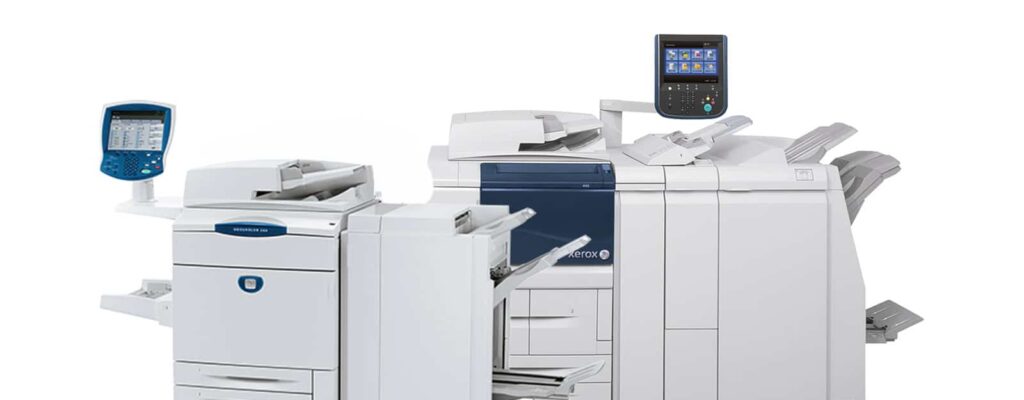
Production presses like Xerox Versant-class devices have long demonstrated how speed, quality, and finishing capabilities support high-volume environments. But now, the machine is just one component of the system.
The real value comes from how well the device is:
-
Integrated into automated workflows
-
Configured for consistency
-
Supported with analytics and monitoring
-
Aligned with finishing and security requirements
A great press without automation is just a fast bottleneck.
FAQs
-
Automation means jobs move through intake, production, finishing, and delivery with minimal manual intervention and consistent results.
-
No. Any organization with repeatable, high-volume, or time-sensitive printing can benefit—especially when complexity is involved.
-
Not always. Many environments can improve automation by reconfiguring workflows, software, and integrations around existing devices.
-
By standardizing presets, validating data before printing, and removing manual setup steps that introduce inconsistency.
-
We help businesses design print environments that actually work—aligning workflows, technology, and outcomes so printing supports the business instead of slowing it down.